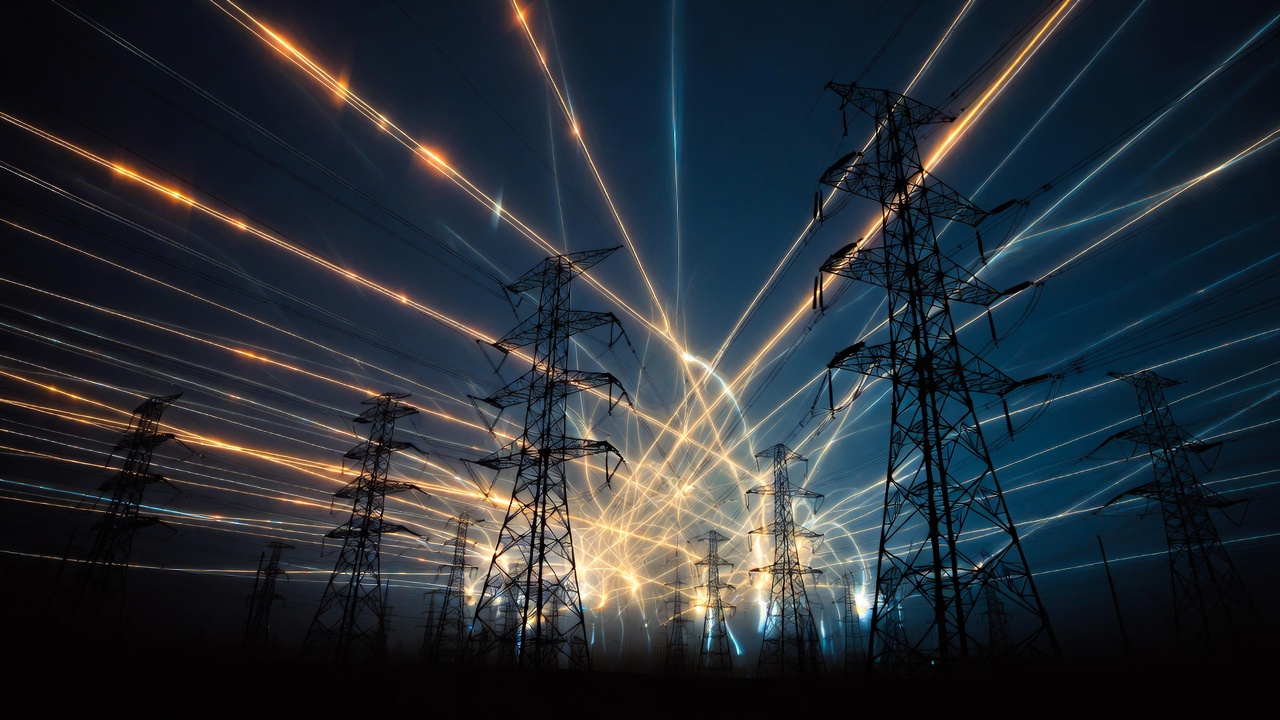
The AI story in early 2026 isn’t about algorithms anymore. It’s about electricity, transmission lines, and who controls the physical layer. Hyperscalers are pouring over $600 billion into data centers this year, but power availability—not chip speed—has emerged as the decisive constraint.
Understanding this shift matters because it determines which companies actually deploy AI at scale over the next decade, and where durable competitive advantages concentrate.
## The Current State: Capital Abundance Meets Infrastructure Scarcity
AI infrastructure dominates capital allocation in 2026. Microsoft, Google, and AWS have committed over $600 billion in CapEx, primarily targeting data centers and advanced semiconductors. U.S. data center capacity has tripled since 2020, yet utilization rates sit at 85-90%, signaling near-term saturation despite massive buildout.
The numbers reveal the scale: Microsoft alone has secured $38 billion in power purchase agreements. Data centers now consume 4-6% of total U.S. electricity, with global consumption projected to surge through 2030 as AI training and inference workloads expand. This isn’t cyclical hype—economic models project 1-2% annual GDP uplift by 2030 from AI productivity gains, assuming the power infrastructure actually materializes.
On the semiconductor side, concentration is extreme. Nvidia commands approximately 92% of data center AI GPU sales, protected by CUDA’s developer ecosystem lock-in. In memory, the bottleneck is even tighter: High Bandwidth Memory (HBM) essential for AI training comes from just three suppliers—SK Hynix (62% market share), Micron (21%), and Samsung (17%). AI training workloads require roughly 10x current HBM capacity by 2028, and production capacity can’t scale that fast.
## Why Power Became the Constraint
AI compute demands double every 6-9 months, driven by larger models and expanded use cases. But unlike cloud storage or bandwidth, you can’t simply spin up new power generation overnight. The infrastructure timeline creates the bottleneck.
Grid interconnection queues average 4-7 years in the U.S., meaning a data center approved today connects to power in 2030 or later. Roughly 50% of U.S. grid assets are approaching end-of-life, requiring replacement before expansion. Regulatory approval processes for new generation capacity—whether natural gas, nuclear, or renewables—add years to deployment timelines.
Capital intensity compounds the problem. Building AI infrastructure at scale requires an estimated $3-4 trillion through 2030. That threshold naturally filters competition, creating oligopolistic market structures where only the largest players with the longest time horizons can participate.
Talent constraints add friction. Each large-scale data center deployment requires 4,000-5,000 specialized workers for construction and operation, inflating costs 15-20% above baseline as competition for expertise intensifies.
## Geopolitical and Supply Chain Vulnerabilities
Taiwan manufactures roughly 80% of advanced semiconductor nodes, creating obvious concentration risk. The HBM oligopoly mentioned earlier sits primarily in South Korea (SK Hynix, Samsung) with Micron as the sole U.S. producer. As AI training scales, this three-supplier structure for a critical input creates pricing power and supply constraints.
Energy inputs face similar concentration. If data center growth drives nuclear renaissance—as some hyperscalers are exploring—uranium supply chains become relevant. China controls approximately 60% of critical mineral processing capacity needed for both advanced batteries and certain reactor designs.
These dependencies explain why U.S. policy has shifted toward domestic semiconductor manufacturing (CHIPS Act) and why hyperscalers are negotiating power agreements years in advance. The strategic layer matters as much as the technical layer.
## Where Structural Advantages Concentrate
Several moats appear durable over 10+ year horizons:
**Nvidia’s position** isn’t just about GPU performance—it’s about CUDA’s software ecosystem. Developers build models, libraries, and workflows around CUDA. Switching to AMD or emerging competitors means rewriting code, retraining teams, and accepting performance uncertainty. This creates 10-15 year defensibility even as hardware commoditizes.
**Hyperscaler infrastructure advantages** compound through scale. Microsoft’s $38 billion in power contracts, Google’s data center network, and AWS’s deployment footprint create first-mover benefits that grow stronger over time. Smaller entrants face not just capital barriers but power availability barriers—there’s simply no grid capacity available in prime locations.
**HBM producers** (SK Hynix, Micron, Samsung) control a genuine bottleneck. Production requires specialized fabrication processes, multi-year capacity expansion timelines, and significant capital investment. With demand growing 10x while only three suppliers exist, pricing power is structural, not temporary.
Regional advantages matter too. The U.S. benefits from proactive permitting in certain states and federal infrastructure stimulus. Europe’s EU AI Act adds approximately 17% compliance overhead, slowing deployment relative to U.S. and UAE, which have taken lighter regulatory approaches.
## Timeline Reality Check
**2026:** Pilot expansions continue, but grid interconnection delays exceed four years for most new projects. HBM supply constraints bind as training workloads scale. Utilization of existing data centers pushes toward capacity limits.
**2027-2028:** Commercial viability depends on grid interconnections actually completing and HBM production ramping. Some regions see capacity come online; others face continued delays. Winners separate from wishful thinkers based on who secured power agreements 5-7 years earlier.
**2029-2030:** Economic productivity gains from AI begin flowing through if infrastructure constraints ease. Market structure solidifies around players who navigated the bottleneck period successfully.
**Beyond 2030:** AI potentially optimizes grid operations and energy systems—but only if the foundational power abundance arrives first. The constraint determines the timeline, not the technology capability.
## Second-Order Effects
AI’s 20-30 GW annual demand growth could accelerate nuclear reactor construction, particularly Small Modular Reactors designed for industrial loads. But uranium supply chains and regulatory approval timelines mean this is a 2030+ story, not a 2026 solution.
Cheaper ahead: compute efficiency improvements through quantization and model optimization are already reducing inference costs by roughly 30%. Training costs may follow as techniques mature.
Scarcer ahead: grid capacity in premium locations, specialized data center construction talent, and HBM supply. Pricing power concentrates where scarcity persists.
## Where Value Compounds
The AI infrastructure boom is real, but power availability determines who captures it. Structural advantages concentrate around:
– Hyperscalers with long-term power contracts and existing data center networks
– The HBM oligopoly facing 10x demand growth with three-supplier capacity
– Whoever solves grid interconnection bottlenecks (utilities, power developers, energy storage providers)
– Software ecosystems with high switching costs (CUDA’s developer lock-in)
These aren’t short-term trades—they’re decade-long positioning advantages based on infrastructure constraints that take years to resolve.
The next decade of AI deployment won’t be determined by which models are smartest. It will be determined by who has access to gigawatts of reliable power when they need it. That’s a slower, less exciting story than algorithmic breakthroughs. It’s also where the durable competitive advantages are being built right now.
Leave a Reply